If you have ever spent an afternoon meticulously testing your pool water only to find that your chlorine levels are 'perfect' but your water is still turning a murky shade of green, you have likely encountered the 'stabilizer trap.' At the heart of this frustration is a chemical called Cyanuric Acid (CYA). Known in the industry as pool stabilizer or conditioner, CYA is often described as 'sunscreen for chlorine.' While it is an essential component of modern pool maintenance, it is also one of the most misunderstood chemicals in your cabinet.
Managing a pool requires a delicate dance between various chemical levels. As outlined in our Master Your Water: The Ultimate Guide to Pool Chemistry for Beginners, every chemical affects another. Cyanuric Acid is unique because, unlike chlorine or pH adjusters, it does not dissipate, evaporate, or break down quickly. It lingers, it builds up, and if left unchecked, it can render your sanitizer completely useless. This guide will dive deep into the science of stabilization and help you determine if your pool is reaching a state of over-stabilization.
What Exactly is Cyanuric Acid?
Cyanuric Acid is a structural analog of ammonia that helps protect Free Chlorine (FC) from being destroyed by the sun's ultraviolet (UV) rays. To understand its importance, you have to understand the vulnerability of chlorine. Without stabilizer, the UV rays from the sun can destroy up to 90% of your pool's free chlorine in as little as two hours. This would require you to constantly pump chlorine into your water just to maintain the CDC-recommended level of 1.0–3.0 ppm.
When CYA is added to the water, it forms a weak chemical bond with the chlorine. It essentially 'holds onto' the chlorine molecules, shielding them from the sun. When bacteria or algae enter the water, the CYA releases small amounts of the chlorine to do its job. However, the more CYA you have in the water, the tighter that grip becomes. This relationship is the foundation of the 'over-stabilization' problem.
The Goldilocks Zone: Ideal CYA Levels
In the world of pool chemistry, balance is everything. For most residential outdoor pools, the industry standard for Cyanuric Acid is between 30 and 50 ppm (parts per million). Within this range, you get the maximum benefit of UV protection without severely inhibiting the killing power of your chlorine.
For a deeper look at how this fits into your overall chemical profile, check out our guide on Master Your Water Chemistry: How to Balance Your Pool's pH Levels Like a Pro. Just as pH must stay between 7.2–7.8 to remain comfortable for swimmers, CYA must stay within its limits to keep the water sanitary.
- Free Chlorine: 1.0–3.0 ppm
- pH: 7.2–7.8
- Total Alkalinity: 80–120 ppm
- Calcium Hardness: 200–400 ppm
- Cyanuric Acid: 30–50 ppm
The Danger of Over-Stabilization (Chlorine Lock)
Over-stabilization occurs when your CYA levels climb above 100 ppm. At this concentration, the 'sunscreen' becomes a 'straightjacket.' The Cyanuric Acid binds so tightly to the chlorine that the chlorine cannot react with organic contaminants. This is known as 'Chlorine Lock.'
You may test your water and see a Free Chlorine reading of 5.0 ppm—well above the 1.0–3.0 ppm CDC standard—yet you still have algae blooms. This is because the effective chlorine is significantly lower than the total chlorine. Science suggests that for chlorine to be effective, your Free Chlorine level should be roughly 7.5% of your CYA level. If your CYA is at 100 ppm, you would need to maintain 7.5 ppm of chlorine just to keep the water clear. If your CYA hits 150 ppm, you would need over 11 ppm of chlorine, which is harsh on the skin, eyes, and pool equipment.
The Silent Build-Up: Where Does CYA Come From?
Many pool owners ask, 'I never added stabilizer, so why is my level so high?' The answer lies in the type of chlorine you use. Most 'pucks' or 'tabs' (Trichlor) and many 'shock' powders (Dichlor) are stabilized. This means they are a mix of chlorine and Cyanuric Acid.
For every 10 ppm of chlorine that a Trichlor puck adds to your water, it also adds roughly 6 ppm of Cyanuric Acid. Because CYA doesn't evaporate, it stays in the pool forever unless you physically remove water. Over a long, hot summer, as you keep adding pucks to maintain your sanitizer levels, your CYA is slowly, silently climbing. By August, a pool that started the season at a perfect 40 ppm could easily be over 120 ppm.
Pro Tip: To prevent CYA creep, consider switching to liquid chlorine (sodium hypochlorite) for regular maintenance. Liquid chlorine is non-stabilized and will not raise your CYA levels, making it the preferred choice for many professionals when the pool is already at its ideal stabilizer range.
How to Test and Lower Cyanuric Acid
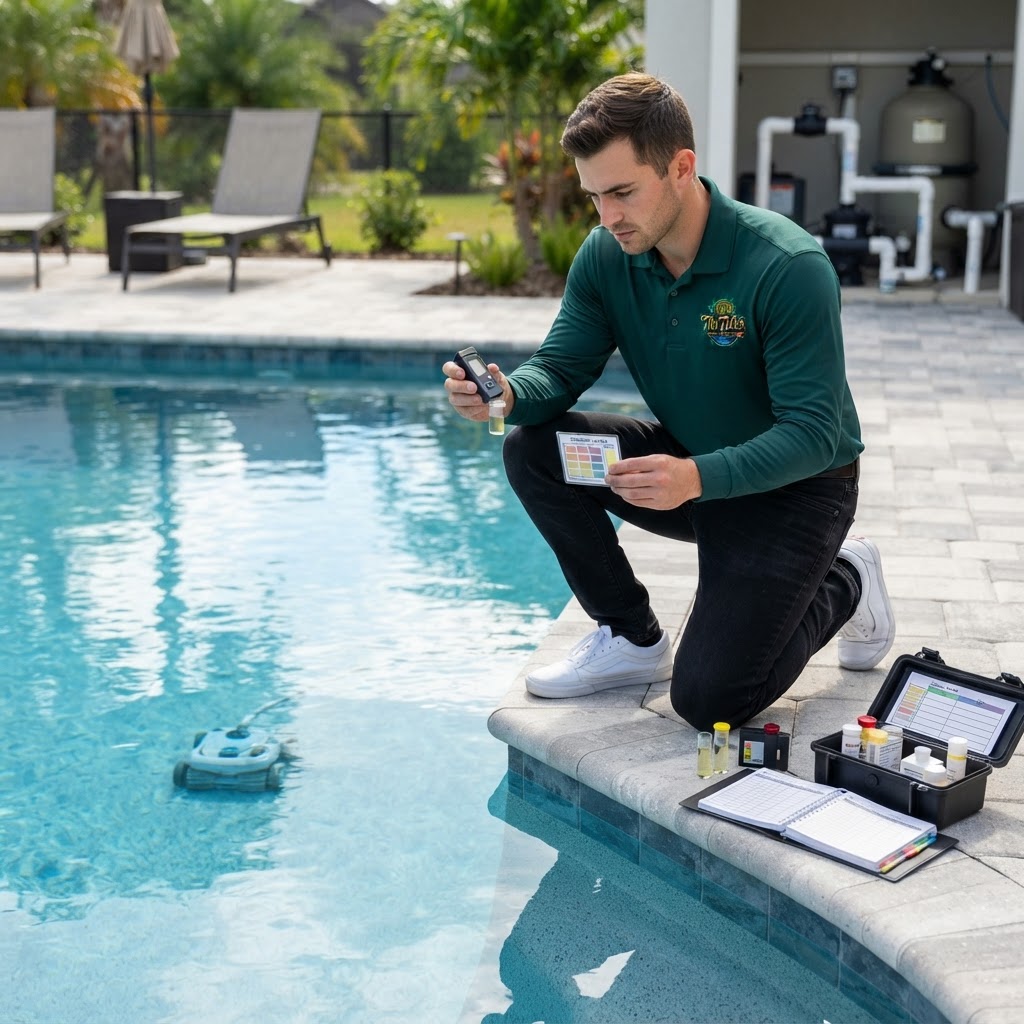
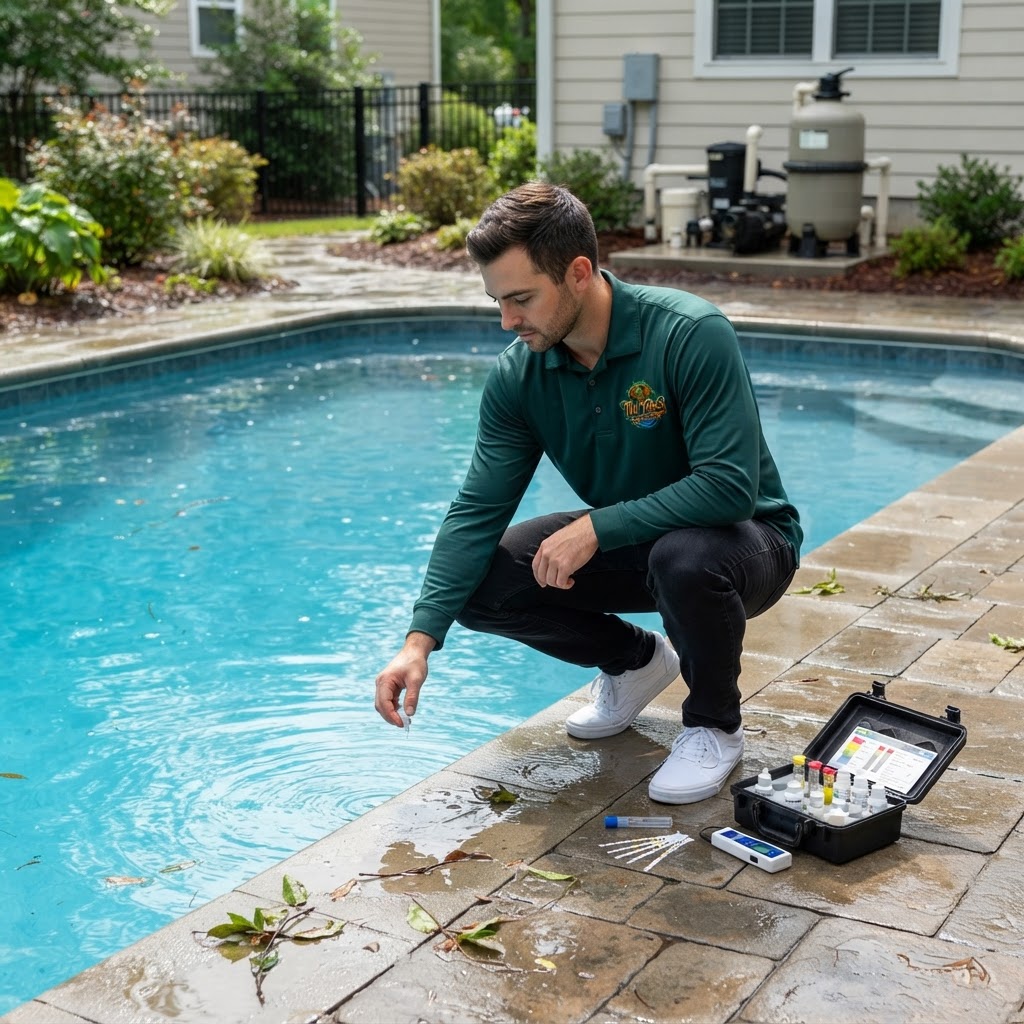
Most basic test strips are notoriously inaccurate for CYA. For a precise reading, use a liquid test kit (like the Taylor K-2006) that utilizes the 'turbidity' or 'disappearing dot' method. This involves mixing pool water with a reagent that turns cloudy in the presence of CYA. You then fill a tube until the black dot at the bottom is no longer visible.
If your test reveals that you are over-stabilized (above 100 ppm), there is only one reliable way to lower it: Dilution.
- Drain a portion of the water: Usually, 20% to 50% depending on how high the levels are.
- Refill with fresh water: Use a garden hose to bring the water back to the mid-skimmer level.
- Circulate and Re-test: Run the pump for 24 hours to ensure the new and old water are fully mixed before testing again.
Quick Reference: Signs of High CYA
- Your pool water is cloudy or green despite high chlorine readings.
- You find yourself needing more and more chlorine to keep the water clear.
- A turbidity test shows the black dot disappearing almost immediately.
- You have been using stabilized pucks (Trichlor) exclusively for more than one season without a partial drain.
Safety Notes
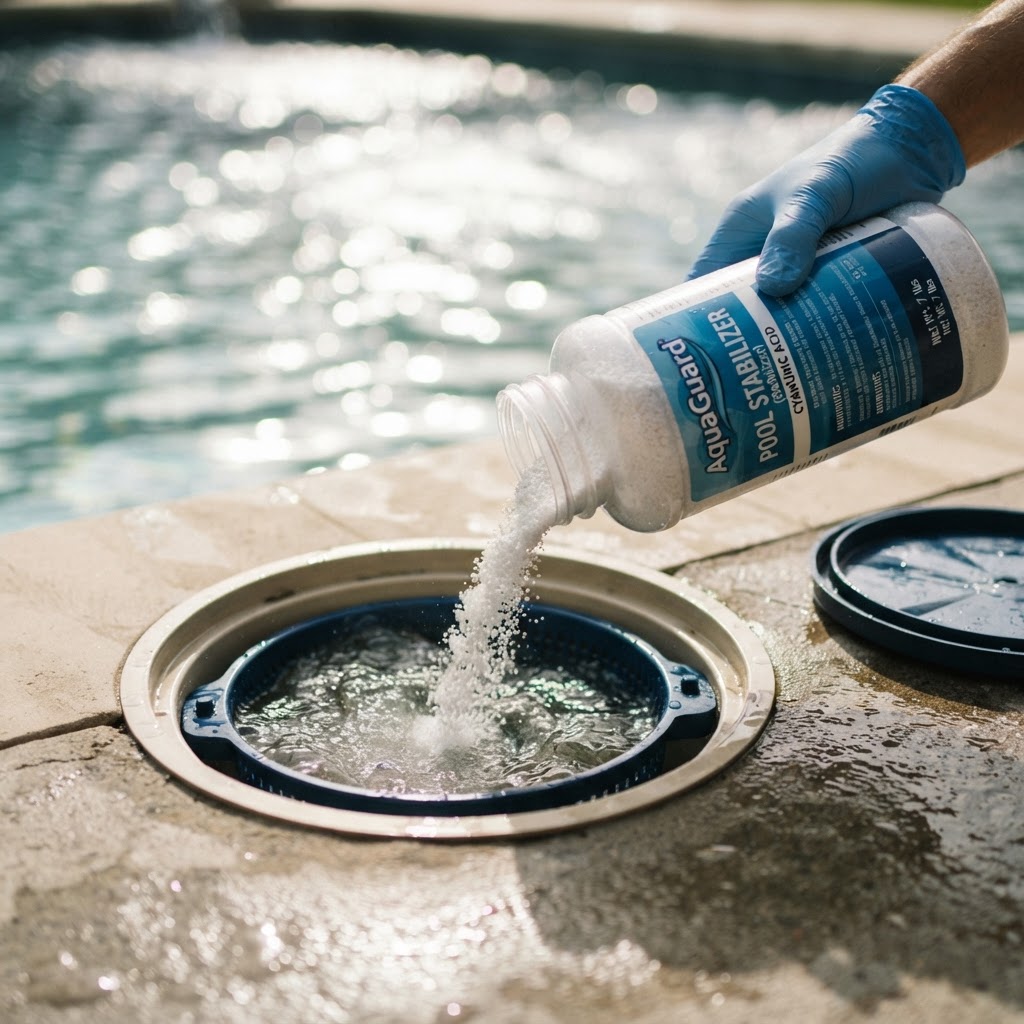
- Chemical Handling: When adding dry Cyanuric Acid to raise levels, never pour it directly into the skimmer as it can take days to dissolve and may damage your filter. Instead, put it in a sock and hang it in front of a return jet.
- Structural Risks: Never drain a pool completely without professional advice. Hydrostatic pressure from groundwater can cause a pool to 'pop' or lift out of the ground, leading to catastrophic structural failure.
- Mixing: Never mix different types of chlorine (e.g., Cal-Hypo and Trichlor) in the same feeder or bucket. This can cause a violent explosion. Learn more about sanitizer differences in our guide on Chlorine vs Bromine: Which Sanitizer Is Right for Your Pool?.
When to Call a Professional
While testing CYA is a DIY task, correcting extreme over-stabilization can be tricky. You should call Tiki Tides Pools if:
- Your CYA levels exceed 150 ppm.
- You are unsure of your local water table levels before draining water.
- You have a salt-water pool (which requires different CYA levels, usually 60-80 ppm).
- You are experiencing persistent algae that 'Chlorine Lock' has made impossible to kill.
Summary
Cyanuric Acid is the unsung hero of your pool’s ecosystem, protecting your chlorine from the sun's harsh rays. However, too much of a good thing can lead to 'Chlorine Lock' and a green pool. By keeping your CYA levels between 30 and 50 ppm and understanding how stabilized chlorine pucks contribute to build-up, you can maintain a crystal-clear pool all season long. Remember: test monthly, use liquid chlorine when necessary, and don't let the stabilizer trap catch you off guard.